

The Best Food Festivals in France to Add to Your 2026 Vacation List (Only the French Would Celebrate Asparagus)
We all know that the French are famous for their food, but which are the best food festivals in France?
There are so many to choose from. From truffles, onions, and chillies to lemons, strawberries, and cherries, the French celebrate them all. And why not?
One of the many things I love about living in France is the freshness of the produce.
The French love to eat what’s in season. What you see in the supermarkets is usually what’s coming out of the fields. If it’s not in season, it won’t be available to buy.
It’s a wonderful way of life, as it’s like stepping back in time to an era when people shopped daily. They’d grab their basket and head for the local market to pick up what they needed for that night’s dinner. And that’s what it’s like here in rural France.
The weekly markets are bursting at the seams with local produce, and nearly everything has its own fête (festival).
Which Are the Best Food Festivals in France
Attending one of these food festivals is hands down the best way to experience France’s food culture, meet local artisans, and immerse yourself in its history.
Nearly every fête has a legend or story behind it, so I hope you’re ready.
No 1 – January, Fête de la Truffle, Sarlat-la-Canéda

Sarlat is in the Dordogne region right here in southwest France, and is known for its foie gras and truffles.
It’s a beautiful Medieval city steeped in history, but in January, the focus is on the revered black truffle, or “black diamond,” as it is often called.
The festival’s legend dates back to the 19th century, when the town of Sarlat was known for its thriving truffle trade.
According to the legend, a young shepherd boy named Jacquot discovered the first truffle in the nearby woods.

The story goes that one day, while tending to his sheep, Jacquot saw his dog digging frantically at the base of an oak tree. Curious, Jacquot investigated and found a strange, knobby object in the soil.
He brought it back to his village, where the locals quickly realised that it was a truffle, a highly prized delicacy in the culinary world.
News of the discovery spread quickly, and soon the forests around Sarlat became a prime location for truffle hunting. The festival includes truffle markets, cooking demonstrations, truffle hunts, and tastings of truffle-infused dishes and wines.
📆 When: 3rd week in Jan | 📍Where: Sarlat, Périgord Region | 🌐 Official Website
No 2 – February, Fête des Bœufs Gras, Bazas

The Fête des Bœufs Gras is a centuries-old tradition that takes place in the town of Bazas, located in the Gironde region in South West France.
It’s dedicated to celebrating the prized Bazadais breed of cattle, known for their rich marbling and succulent meat. The festival typically takes place on the Thursday before Mardi Gras, also known as Fat Thursday.
According to legend, the origins of the Fête des Bœufs Gras de Bazas date back to the Middle Ages.
Apparently, a local lord, impressed by the quality of the cattle in the area, declared that every year he would award the fattest and most beautiful animal with a prize.
Over time, this tradition evolved into a festival, with the cattle being paraded through the town and judged by a panel of experts.
Another version of the legend suggests that the tradition of fattening cattle began in the 16th century when the Archbishop of Bordeaux granted the town of Bazas the right to hold a weekly market.
To make their cattle more attractive to buyers, the locals began fattening them up, and this practice eventually evolved into the Fête des Bœufs Gras.
📆 When: Feb Thursday before Mardi Gras | 📍Where: Bazas, Gironde | 🌐 Official Website
No 3 – February, La Fête de Citron, Menton

Famous for its lemons, the town of Menton on the French Riviera celebrates all things citrus for two weeks. You’ll see huge sculptures made from oranges and lemons, which get sold off to locals for jam-making at the end of the festival.
One of the highlights is the night parades with huge carnival floats adorned with fruit, with dancing and music troupes from around the world.
The legend behind the festival dates back to the late 19th century, when the town’s citrus growers were looking for a way to promote their products.
According to the story, a group of growers hit upon the idea of creating a festival featuring lemon and orange floats, inspired by the famous carnival in Nice.
The first Lemon Festival was held in 1934, and it quickly became a popular event, drawing visitors from around the world.
📆 When: Middle of Feb to start of Mar | 📍Where: Menton, French Riviera | 🌐 Official Website
No 4 – March, Foire au Boudin, Mortagne-au-Perche

This annual event celebrates the humble sausage in Mortagne-au-Perche in the Normandy region of France.
Artisans from all over Europe gather to showcase everything from black pudding, for which the town is known, to white pudding, tripe, and charcuterie.
You’ll also find some of France’s best cheeses, wines, ciders, and spirits.
The origins of the Foire au Boudin are unclear, but the fair has been held for several centuries.
Some historians believe the fair may have originated in the Middle Ages, when farmers slaughtered their pigs in the winter and used every part of the animal for food.
Blood sausage was a popular dish, and it’s possible that the fair was originally held to allow farmers to trade their sausages with each other.
📆 When: Middle of March | 📍Where: Mortagne-au-Perche, Normandy | 🌐 Official Website
No 5 – April, Foire au Jambon, Bayonne

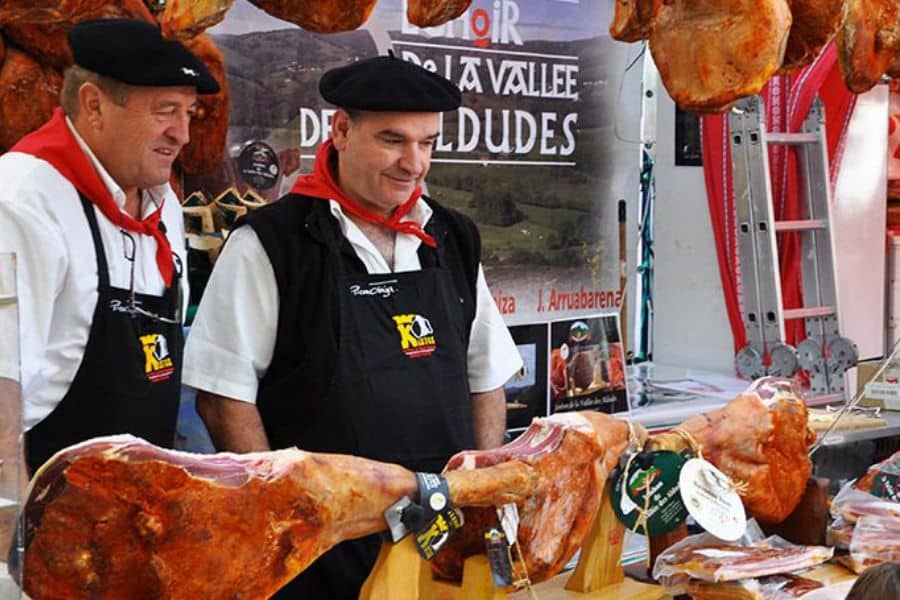
Located in the Basque region of southwestern France, the fair is dedicated to the local delicacy of Bayonne ham, a cured ham made from the hind leg of a pig.
There’s a market selling a variety of hams and other pork products, as well as food stalls serving traditional Basque dishes like piperade and Axoa.
There are also parades, concerts, and other events, as well as competitions to determine the best ham of the year.
Dating back to 1462, the story of Bayonne Ham apparently comes from the Hundred Years’ War between France and England.
The Duke of Lancaster, who was also the King of Castile, married a French princess and acquired the duchy of Aquitaine, which included Bayonne.
To celebrate his new territory, the Duke introduced a new culinary tradition to Bayonne: the art of curing ham.
The local farmers soon adopted this technique, and over time, they perfected their own recipe for Bayonne ham, which became famous throughout France and beyond.
📆 When: April, the time varies | 📍Where: Bayonne, Basque Country | 🌐 Official Website
No 6 – April, Fête de l’omelette Géante, Bessières

This annual event takes place in the town of Bessières, located in the Occitanie region of southwestern France.
The festival is dedicated to the culinary tradition of making a giant omelet, using dozens of eggs and other ingredients.
According to legend, the tradition of making a giant omelette dates back to the 16th century, when Napoleon Bonaparte and his army were traveling through the south of France.
One night, the soldiers stopped in Bessières and were invited to a meal by a local innkeeper.
The innkeeper made an omelet for the soldiers, using all the eggs in the village. Napoleon enjoyed the dish so much that he ordered the innkeeper to make a giant omelet for his entire army the next day.
Ever since that time, the people of Bessières have continued the tradition of making a giant omelet to celebrate Easter.
The omelet is made with at least 15,000 eggs, onions, bacon, and other ingredients, and cooked in a giant pan heated over an open flame. Once cooked, it’s cut into pieces and distributed to the festival-goers.
📆 When: Start of Arpil | 📍Where: Bessières, Haute-Garonne | 🌐 Official Website
No 7 – May, La Fête de la Fraise, Beaulieu-sur-Dordogne

Just down the road from where I live in the Charente, the strawberry festival is an annual festival in the Limousin region of South West France. It’s dedicated to the locally grown Gariguette strawberry and celebrates the arrival of spring.
One of the festival’s legends dates back to the time of the Knights Templar, who were known for their expertise in horticulture.
The knights brought the first strawberry plants to Beaulieu-sur-Dordogne from the Middle East, and the locals soon adopted the practice of growing them.
To find out more, visit the Fraise de Beaulieu website >>>
No 8 – April, The Blayais Asparagus Festival, Blayais

Until I came to France, I’d never seen white asparagus before, but here it is a big vegetable item you’ll often see at the daily markets.
Blayais is celebrated for its asparagus, and this reputation stems from a unique blend of historical, geographical, and climatic factors.
The soil in Blayais is particularly well-suited for asparagus cultivation, being rich in nutrients and possessing the ideal structure that asparagus plants require to thrive.
Additionally, the climate in this region plays a significant role. With its balanced temperatures and adequate rainfall, it creates an optimal environment for asparagus growth.
The festival began as a local celebration marking the onset of spring and the asparagus harvest, but it’s developed into a huge weekend party. It attracts visitors not just from around France but internationally too.
There are asparagus tastings featuring various dishes showcasing different ways to cook it, with renowned chefs giving demonstrations. Of course, local artisans are selling fresh asparagus and other local produce.
Plus, local music with dancing, workshops on agriculture, cooking, and even asparagus-themed art, and tours of the asparagus farms.
📆 When: End of April📍Where: Étauliers, Gironde | 🌐 Official Website
No 9 – May, Fête de la Cerise, Céret
May is the month for cherries, and the Cherry Festival takes place annually in the town of Céret, located in the Pyrénées-Orientales department in southern France. It’s a wonderful way to celebrate the cherry harvest with two days of markets, tastings, and live music.
Part of the celebrations includes a spitting of the pips competition. I’m not sure exactly what’s involved, but I’d love to find out.
It’s said that the Romans brought the first cherry trees to Céret from Italy, and from there they’ve become a local produce celebrated every year.
📆 When: Towards the end of May | 📍Where: Céret, Pyrénées-Orientales | 🌐 Official Website
No 10 – July, Féria du Melon, Cavaillon

The melon festival takes place in the town of Cavaillon, located in the Provence region of southern France.
It’s all about celebrating the harvest of the melon. There are some great traditions during the festival.
The Brotherhood of Knights of the Order of the Cavaillon Melon taste the melons to decide who has produced the best harvest.
The main highlight of the weekend is the running of 100 Camargue horses around the streets. So much fun to watch the whole thing unfold.
📆 When: The weekend before July 14th | 📍Where: Luberon, Provence | 🌐 Official Website
No 11 – August, Fête de l’Oignon de Roscoff, Roscoff

The pretty harbor town of Roscoff on Brittany’s north coast is famous for its onions, especially the pink variety. There are onion-string-plaiting competitions, visits to farms, Breton music, and dancing.
Plus huge vats of confit onions cooked and served on the local speciality galette-saucisse.
Apparently, the onion was first brought to the region by Friar Cyril, a Capuchin monk, in 1647 after a trip to Portugal.
But it wasn’t till 1828 when a young peasant from Roscoff, Henri Ollivier, took some onions to England, that their value was appreciated. He sold everything he took and realized that money could be made from selling them.
Throughout the late 19th and early 20th centuries, the “Onion Johnnies” would sell them door-to-door from the handlebars of their bicycles in Britain.
We’ve all seen the pictures from the 1930s of Frenchmen with strings of onions around their neck.
📆 When: 3rd weekend in August | 📍Where: Roscoff, Brittany | 🌐 Official Website
No 12 – August, Fête de la Figue, Solliès-Pont

Solliès-Pont is in the Gapeau Valley in Provence and is famous for its fig orchards. They produce about 2,500 tons of the fruit each year, and 75% of France’s entire fig harvest.
The region is famous for its “Violette de Solliès” variety of fig, which is purple with huge leaves that can often be the size of dinner plates.
The first evening of the festival hosts a dinner held in the town square, where each course features figs in some way.
During the festival, there are cooking demonstrations, fig trails through the valley, and you’ll also have the opportunity to taste and buy a wide variety of figs, including fresh figs, dried figs, fig jams, and fig liqueurs.
📆 When: Last weekend in August | 📍Where: Solliès-Pont, Provence-Alpes-Côte d’Azur
No 13 – October, Fête de la Châtaigne, Collobrières

Seeing chestnuts roasting reminds me of Christmas, ice rinks, and clutching a mug of hot chocolate.
However, in the small town of Collobrières, about an hour away from Saint-Tropez within the Massif des Maures, are cork oak and chestnut forests.
For three Sundays in October, the town celebrates the chestnut harvest.
With a wonderful carnival atmosphere of parades and concerts, you’ll be able to eat roasted chestnuts, drink chestnut wine, and try chestnut paste.
If you’ve never had chestnut wine, you don’t know what you’re missing. The local artisans attend the farmers’ market, and the smells coming from the different stalls are just wonderful.
📆 When: Middle of October | 📍Where: Collobrières, Provence | 🌐 Official Website
No 14 – October, Fête de Piment, Espelette

One thing I noticed when I first moved to France was the fact that the French aren’t keen on spicy food. However, the piment d’Espelette is a gentler chilli.
A native of Mexico, it’s been cultivated in the Basque Country since the 16th century.
The festival marks the end of the harvest and is celebrated in style with a parade of floats decorated with dried chillies.
There’s plenty of traditional Basque music and dancing with locals all dressed in traditional outfits of red and white.
One of the highlights of the festival is the chilli eating contest to see who can eat the most hot peppers in a set amount of time. I’m not good with anything too hot, so there’s no way you’d catch me doing this.
But it’s a fun way to see how high your tolerance for spicy foods really is.
📆 When: Towards the end of Oct| 📍Where: Espelette, French Basque Region | 🌐 Official Website
No 15 Salon du Chocolat (The Chocolate Fair), Paris

Who wouldn’t love a festival all about chocolate? It’s seriously one of the best food-inspired events I’ve ever been to.
Originating in 1994, it was dreamed up by Sylvie Douce and François Jeantet, two chocolate enthusiasts who wanted to create a platform for chocolate and cocoa professionals and enthusiasts to gather, share, and celebrate their passion.
It takes place at the Porte de Versailles Exhibition Centre and is a sensory and educational experience like no other, featuring the biggest selection of chocolate producers you’ve ever seen, from renowned international brands to artisan chocolatiers, showcasing their products.
There are numerous stands where attendees can taste and buy a wide variety of chocolates. The event also includes live demonstrations by top chefs and chocolatiers, chocolate-making workshops, and conferences and discussions on topics related to chocolate and cocoa.
One of the highlights is the Chocolate Fashion Show, where models walk the runway in stunning outfits made of chocolate, created by collaborations between chocolatiers and fashion designers.
This unique fusion of fashion and chocolate artistry is a must-see spectacle that draws significant attention.
📆 When: End of October📍Where: Porte de Versailles, Paris | 🌐Official Website
No 16 – November, La Fête du Beaujolais Nouveau

Beaujolais Nouveau is a young red wine made from Gamay grapes in the Beaujolais region of France. The wine is released on the third Thursday of November every year, just a few weeks after the grapes are harvested.
At the stroke of midnight, bottles are cracked open, and it’s party time. I’ve been to a few of these celebrations, and all I can say is you need to pace yourself.
The release of Beaujolais Nouveau began as a local tradition in the Beaujolais region, where winemakers would share a taste of the new wine with friends and family shortly after the harvest.
In the 1950s, this tradition was commercialised by a local winemaker, Georges Duboeuf, who saw the potential to market the wine as a seasonal celebration.
📆 When: 3rd Thursday in Nov | 📍Where: Beaujolais, Burgundy | 🌐 Official Website
No 16 – Mid-December, Fête de la Dinde, Licques

The village of Licques is in the Pas-de-Calais region in northern France and is famous for its poultry. It was in the 17th century that monks from the local abbey began rearing turkeys.
They’ve now developed into their own breed known as the “Dinde de Licques”.
The event starts with la potée, a massive cauldron of turkey soup sitting on a big open fire to keep it warm and served to those attending.
As always, there’s a market with local produce offering everything, including turkeys, cheese, honey, and wine. A great place to stock up for Christmas.
One of the main traditions of Fête de la Dinde is the parade of turkeys. Hundreds of turkeys are decorated with ribbons and led through the streets by their owners; it’s quite a sight to see.
According to local legend, a golden turkey once appeared in Licques and was captured by a local farmer. The bird was so prized that the farmer refused to sell it and instead kept it as a pet.
The legend of the golden turkey is still celebrated today, and a golden turkey is even featured in the parade.
📆 When: Middle of Dec | 📍Where: Licques, Hauts-de-France | 🌐 Official Website
No 17 Les Habits de Lumière, Épernay

Ok, so this isn’t strictly speaking a food festival, but where food is being served, drink shortly follows. And my favorite tipple is champagne, and Epernay is the unofficial capital of champagne.
The festival celebrates the Champagne region’s heritage and its world-renowned sparkling wine.
The light shows and illuminations are amazing, with what seems like every building lit up with 3D mapping. Not to mention the street parades and performances.
One of the main attractions is, of course, the Champagne tasting, where visitors can taste and learn about various Champagne styles directly from the producers.
Alongside this, there are gourmet food stalls and events where local and national chefs display their culinary skills, often pairing dishes with the perfect Champagne.
The highlight for many is “Habits de Saveurs,” a series of gastronomic events in which top chefs prepare exquisite meals, perfectly paired with fine Champagnes, showcasing the exceptional culinary heritage of the region.
📆 When: Mid December | 📍Where: Epernay, Champagne Region | 🌐 Official Website
Final thoughts: French Food Festivals
TRAVELLING TO FRANCE?
Here are my favourite resources I use each time I travel!
🧳 I always protected my trips with this travel insurance company when I lived in the US AND this one now I live in Europe
🚘 I found a car rental for $500 less than traditional sites with this car rental agency
🚌 🍷 My favourite platform to find Day Trips and Wine Tours in France at the best price and with great reviews
🚂 The cheapest train tickets are always on this App
🏨 I got a 20% discount on a chateau hotel with this hotel booking tool
I personally use these sites myself and if you use them, they will earn me a small commission at no extra cost to you. This helps reduce the ever-increasing cost of maintaining my blog and writing about France. Thank you!