

12 Gorgeous Towns in France for American Tourists Who Love History: First-Timer’s Guide
There’s something about walking into a French town for the first time and realizing the cobbles under your feet were laid before Columbus had even thought about America.
The houses lean into the street the way they did 500 years ago, and that market square you’re wandering around hosted hangings and proclamations, and bread riots. The fountain in the middle is the same one people came to with their buckets every morning.
That’s what I love about France, and it’s why I keep traveling around it. The history isn’t tucked away in museums; it’s right there in the building you’re eating lunch in, the wall your hotel is built into, the church bell that’s been ringing since the 1300s. Once you start noticing, you can’t stop.
So if you’re planning your first trip and you love history as much as I do, this list is for you.
12 Towns in France to Visit if You Love History
Twelve towns spread across France, from the Atlantic coast to Provence, each with stories worth a detour. I’ve kept it to towns rather than villages because you can actually base yourself there and use them as a launchpad for more.
Rouen, Normandy
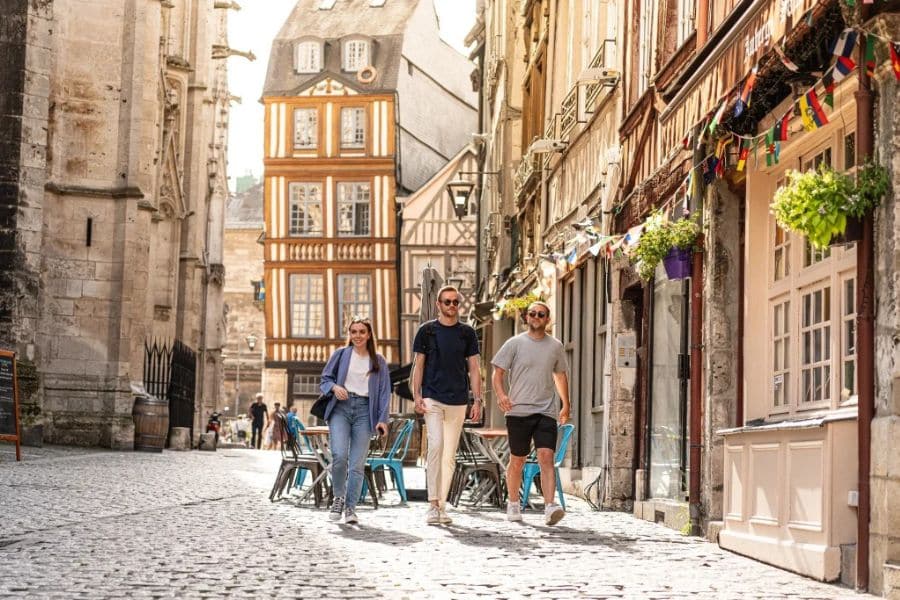
Joan of Arc was burned at the stake in the Place du Vieux-Marché on May 30, 1431. She was nineteen. A modern church now stands on the spot where the pyre was lit, and the cross marking the exact place sits just outside its doors.

You can stand on those cobbles and look down at it, which is a strange feeling when you remember she had led the French army to victory at Orléans just two years before.
The old town survived more than most Norman cities did during World War II, which means you still get a tangle of half-timbered streets that look nearly the same as they did in the 15th century.

Don’t miss Le Gros Horloge, an astronomical clock from 1389 with a single hand and a working mechanism that’s older than Columbus’s voyage.
For the full Joan of Arc story, the Historial Jeanne d’Arc inside the former Archbishop’s Palace walks you through her trial in the very rooms where it took place.
Saint-Malo, Brittany
I recently went back to Saint-Malo after taking the ferry back to the UK to see family, and once again, I was blown away by the history of this town. It was its own republic in the 16th century. Not part of France, not part of Brittany, just itself.
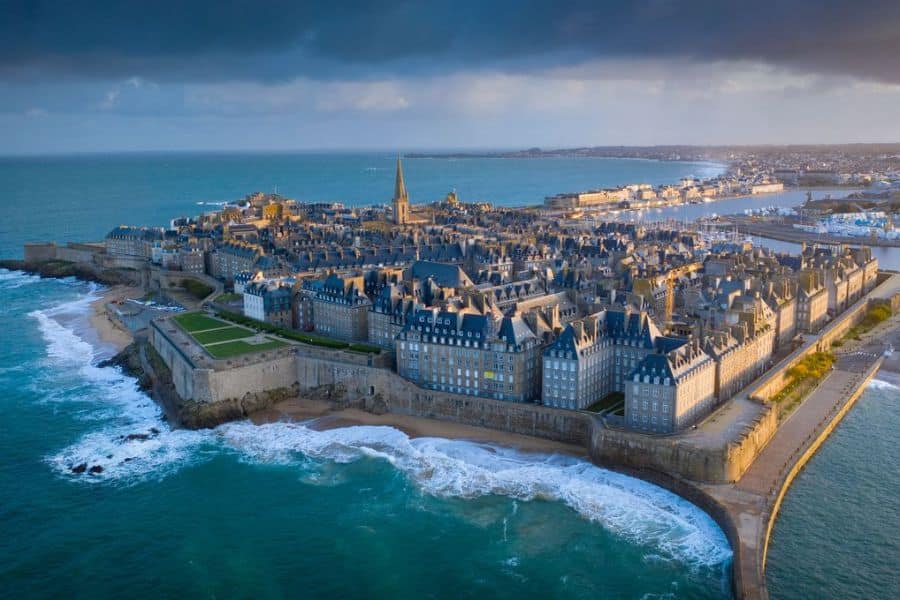
The locals had a saying: “Ni Français, ni Breton, Malouin suis.” Not French, not Breton, I am Malouin. They flew their own flag above the French one, and they still have special dispensation to do so today.
The town made its fortune from corsairs, which were essentially pirates with paperwork. The king of France permitted them to raid English and Dutch ships, and they kept a cut of everything they took. Some became extraordinarily rich and built the granite mansions you can still see inside the walls.

In August 1944, American shelling destroyed about 80% of the old city, but the French rebuilt it stone by stone using the original granite and historical photographs. What looks ancient is mostly a meticulous reconstruction, which I think makes it more remarkable, not less.
Read my full guide to Saint-Malo here.
La Rochelle, Charente-Maritime
In 1627, Cardinal Richelieu showed up outside La Rochelle and decided to starve it into submission. The town was the last major Protestant stronghold in France, and Richelieu wanted that to end.

He built a sea wall across the harbor entrance to cut off English supplies and then waited. The siege lasted 14 months. Of the 28,000 people inside the walls when it began, fewer than 5,000 were still alive when it ended.
Today, the three medieval towers guarding the old harbor are what most people come to see, and they’re worth every euro of the combined ticket. The Tour de la Lanterne served as a prison for centuries, and English and Dutch sailors carved graffiti into the walls that you can still trace with your fingers.

The Tour Saint-Nicolas is essentially a fortress within a fortress, with rooms stacked on top of each other like a stone wedding cake.
For the rest of what makes the town special, check my La Rochelle guide here.
Strasbourg, Grand Est
Strasbourg has changed hands between France and Germany five times since 1681. Once you know that, the city makes sense in a way it doesn’t otherwise. The street names appear in both languages. The food is half French, half German. The architecture in the Petite France quarter looks like it belongs in the Black Forest, while the cathedral is pure French Gothic.

Johannes Gutenberg lived here from 1434 to 1444, and it was during those Strasbourg years that he worked out the early mechanics of his printing press. He left for Mainz before he finished the famous Bible, but the breakthrough happened on these streets.

The cathedral itself was the tallest building in the world for 227 years, from 1647 to 1874, and the astronomical clock inside performs at 12:30 every day. The figures rotate, death strikes the hour, and Christ blesses the apostles. It’s been doing this since 1842.
For Christmas-time visits, my Strasbourg Christmas guide is here.
Colmar, Alsace
The sculptor who made the Statue of Liberty was born here in 1834. Frédéric Auguste Bartholdi grew up in a house on what is now Rue des Marchands, and that house is now a museum filled with his models, sketches, and tools.

Standing in his old courtyard, you can see a 12-meter replica of Liberty herself, which sits at the northern entrance to town.
Colmar came through both World Wars almost untouched, which is why the old center looks the way it does. The half-timbered houses around Place de l’Ancienne Douane date to the 14th and 15th centuries, and in some cases, the painted facades have been maintained by the same families for generations.

The Unterlinden Museum holds the Isenheim Altarpiece, painted between 1512 and 1516 by Matthias Grünewald for a hospital that treated patients with ergotism. The figures on the altarpiece show the symptoms of the disease, which was the artist’s way of telling sufferers that Christ understood their pain. It’s one of the most powerful paintings in Europe, although many people have never heard of it.
More on the region in my Colmar and the Alsace Wine Route post.
Amboise, Loire Valley
Leonardo da Vinci died here on May 2, 1519. He had spent the last three years of his life as a guest of King François I, living in the Clos Lucé manor house just a short walk from the royal château.

The king reportedly visited him often through an underground tunnel that connected the two buildings, though whether the tunnel actually exists has been debated for centuries.

What’s not debated is that Leonardo brought three paintings with him to Amboise, including the Mona Lisa, which is why she now lives in Paris instead of Florence. He’s buried in the Chapel of Saint-Hubert on the grounds of the royal château, though the original tomb was destroyed during the Revolution and his bones were moved more than once.
The château itself was the principal royal residence in the late 15th and early 16th centuries, and the views over the Loire from the terrace are some of the best in the valley.
Sarlat-la-Canéda, Dordogne
Sarlat has one of the highest concentrations of medieval and Renaissance buildings in Europe per square meter. This is because the town stopped growing in the 17th century and remained broke for the next 300 years, which meant nobody had the money to knock anything down and start over.

In 1962, the French government chose Sarlat as the test case for a new heritage law, the Loi Malraux, which paid for the restoration of the old quarter. The town went from forgotten to spectacular in about a decade.
You’ll find walnut and truffle markets that have operated since the Middle Ages, with January the peak season for black truffles. The Maison de La Boétie was the birthplace of Étienne de La Boétie, who wrote one of the most influential political essays in French history at age 18 in 1548.

He died at 32, but the friendship he formed with Michel de Montaigne shaped the development of the personal essay as a form.
More on what to do in town in mySarlat guide.
Bergerac, Dordogne
The Cyrano de Bergerac of the famous play never actually lived in Bergerac. The real Cyrano was a 17th-century Parisian playwright and duelist who borrowed the name from a family estate near Sens. The town has fully embraced the confusion anyway, and there are two statues of him in the old quarter.

The actual history of Bergerac is more interesting than the fictional version. It was a major Protestant stronghold during the Wars of Religion in the 16th century, and the Peace of Bergerac was signed here in 1577.

The town also built its fortune on tobacco, which is why the Musée du Tabac exists in a 17th-century mansion on Rue de l’Ancien Pont. It holds one of the most complete collections of smoking artifacts in the world, going back 3,000 years.
More on the town of Bergerac in my guide.
Angoulême, Charente
Angouleme is only 25 minutes from where I live, and the Romans called it Iculisma. The town sits on a plateau 80 meters above the river Charente, which is why the ramparts feel so high when you walk them.

Those ramparts are 2.5 kilometers long and offer one of the longest continuous medieval walks of any French city, and you can do the whole loop in about 40 minutes.
Isabella of Angoulême was crowned Queen of England in 1200 when she married King John. She was 12 years old and had been promised to another French nobleman, which set in motion a chain of events that contributed to the loss of most of England’s French territories.

After John died, she came home to Angoulême and married the son of the man she’d originally been engaged to, then spent the rest of her life trying to keep her sons (including Henry III of England) from undoing the political alliances she’d built.
Her story is far more interesting than most people realize, and I’ve written about Isabella of Angoulême in detail here. Practical tips for visiting are in my Angoulême travel guide.
Carcassonne, Occitanie
Carcassonne is the largest medieval fortified city in Europe, with 52 towers and two complete rings of walls totaling almost three kilometers. The site has been occupied since the 6th century BC, but what you see today was substantially rebuilt by the architect Eugène Viollet-le-Duc in the 19th century.

He was criticized at the time for adding pointed slate roofs to the towers, which were more typical of northern France than the Mediterranean south. Local architects pointed this out, but he did it anyway, and the roofs are still there.
The walled city very nearly didn’t survive. In 1849, the French government decided to demolish it, and the order was issued. It took a public outcry led by local historian Jean-Pierre Cros-Mayrevieille to reverse the decision.

By 1853, restoration had begun instead of destruction. The town was the last major stronghold of the Cathars, who held it until 1209 when Simon de Montfort’s army took it during the Albigensian Crusade. I’ve written more on Carcassonne Castle and a full Carcassonne Guide.
Béziers, Occitanie
On July 22, 1209, the crusader army arrived at the gates of Béziers and demanded that the town hand over its Cathar heretics. The Catholic residents refused to give up their neighbors.

So the crusaders attacked, broke through the walls, and were faced with the question of how to tell Catholics and Cathars apart inside the city. The papal legate Arnaud Amaury reportedly answered: “Kill them all. God will know his own.”
Around 20,000 people died that day. The town was burned to the ground, and the message was clear across the Languedoc: resist the crusade, and this happens to you. Modern historians have questioned whether Arnaud Amaury actually said those exact words, but the massacre itself is well documented, and the phrase has stuck for more than 800 years.

Béziers today is a working southern French town with the cathedral of Saint-Nazaire rebuilt on the ruins of the one burned in 1209. The view from the cathedral terrace over the Orb river is one of the most striking in the south of France. The full story of Béziers is here.
Aix-en-Provence, Provence
Aix was founded by the Romans in 123 BC as Aquae Sextiae, named for the hot springs that still bubble up around town. It became the capital of Provence in the 12th century and remained so until the Revolution.

The Cours Mirabeau, the wide tree-lined avenue at the center of town, was built in the 17th century on the site of the old city walls, and the four fountains running down its length include one that still flows with naturally hot thermal water.
Paul Cézanne was born here in 1839 and painted Mont Sainte-Victoire, the mountain east of town, more than 60 times. His studio at Atelier des Lauves has been kept exactly as he left it when he died in 1906, with his coat still hanging on the hook and the still-life objects he used set up on the table.

The town has marked a walking trail with bronze C’s set into the pavement that takes you to all the important sites in his life.
Full guide in my Aix-en-Provence post.
TRAVELLING TO FRANCE?
Here are my favourite resources I use each time I travel!
🧳 I always protected my trips with this travel insurance company when I lived in the US AND this one now I live in Europe
🚘 I found a car rental for $500 less than traditional sites with this car rental agency
🚌 🍷 My favourite platform to find Day Trips and Wine Tours in France at the best price and with great reviews
🚂 The cheapest train tickets are always on this App
🏨 I got a 20% discount on a chateau hotel with this hotel booking tool
I personally use these sites myself and if you use them, they will earn me a small commission at no extra cost to you. This helps reduce the ever-increasing cost of maintaining my blog and writing about France. Thank you!