

10 Places in France You May Not Know But You’ll Thank Me For Recommending (Truly Spectacular Places to Visit)
Just when I think there can’t be anything else for me to discover in France, I find something new. From the fossil I found behind the door in the little barn opposite our house the other day when we were clearing it out, to discovering the tombstones of 70 Knights Templar just up the road from where I live.
One of the wonderful things about living here is the history. The French are so proud of their heritage, and they work hard to preserve it for people to enjoy and learn from.
It really is like stepping back in time here as you walk through the little villages that look like they belong in another era completely.
10 Places in France to Visit This Year
I’ve spent the last few years exploring France, and these recommendations are among some of my favorite places I’ve visited. I hope you enjoy reading about them and going to them as much as I did.
Swim in a Tidal Pool in Saint Malo

I visited Saint Malo earlier this year after getting the ferry back to France from Portsmouth, and fell in love with the place. Plage de Bon Secours sits just outside the ramparts of Saint Malo, and it has one of France’s most unusual features: a seawater tidal pool cut right into the rocks.
At high tide, the pool nearly disappears, with only the diving board poking above the surface. At low tide, it reveals itself fully, and in the summer months, it’s a swimmer’s paradise. The views across to Dinard and the islets of Grand Bé and Petit Bé are spectacular.
The pool was built in 1936 by René Lesaunier, who ran a beach bathing business on Bon Secours and had a problem: when the tide went out in Saint Malo, it went far. Saint Malo has some of the biggest tidal ranges in Europe, up to 13 meters in certain conditions.
His customers were drifting off to other beaches, so he took matters into his own hands and had the pool built to keep the water level even when the sea retreated. Nobody thought it would work, but they were wrong. It has been one of the most photographed spots on the Brittany coast ever since.
Taste Cheese in the Town of Camembert

The village of Camembert is in Normandy, and yes, this is where the cheese came from. It’s a tiny place in the Orne department. While it’s not much more than a handful of farms and rolling hills, it does have a museum called the Maison du Camembert, where you can see how the cheese is made and compare different types, including a raw milk Camembert de Normandie AOP against the pasteurized version you find in most supermarkets.
The origin story dates back to 1791 and a farmer named Marie Harel, who, according to legend, gave shelter to a priest fleeing the French Revolution. The priest was from the Brie region and, in gratitude, apparently shared what he knew about cheesemaking. Harel adapted the technique to the milk and methods of her Norman farm, producing something new.
The cheese eventually reached Napoleon III, whose son-in-law, Victor Paynel, served it to the emperor. He loved it, and from that point it was on every table in France. By World War I, Camembert was being shipped to the front in round poplar wood boxes, which kept it fresh enough to travel. Those boxes are still used today with their little bit of red and white material inside.
Eat Figs in the Solliès Basin in Provence

If you’ve never tasted a fig straight from the tree, warm from the sun, on a late August afternoon in Provence, add it to your list. The Solliès basin in the Var, just north of Toulon, produces 71 percent of all the fresh figs grown in France.
The variety grown here is called the Bourjassotte Noire, or Violette de Solliès, and it earned its AOC in 2006 and a PDO in 2011. Michelin-starred chef Guy Savoy is among the chefs who use only Solliès figs.
Fig cultivation in this part of Provence dates back to the Middle Ages. The basin sits between the limestone hills to the west and the crystalline Massif des Maures to the east, and the microclimate is among the sunniest in France.
In 1907 alone, the train station at Solliès-Pont was shipping 1,800 kilograms of fresh figs every single day during peak season. A fig festival is held on the last weekend of August every year.
See the Postman’s Palace in Drôme

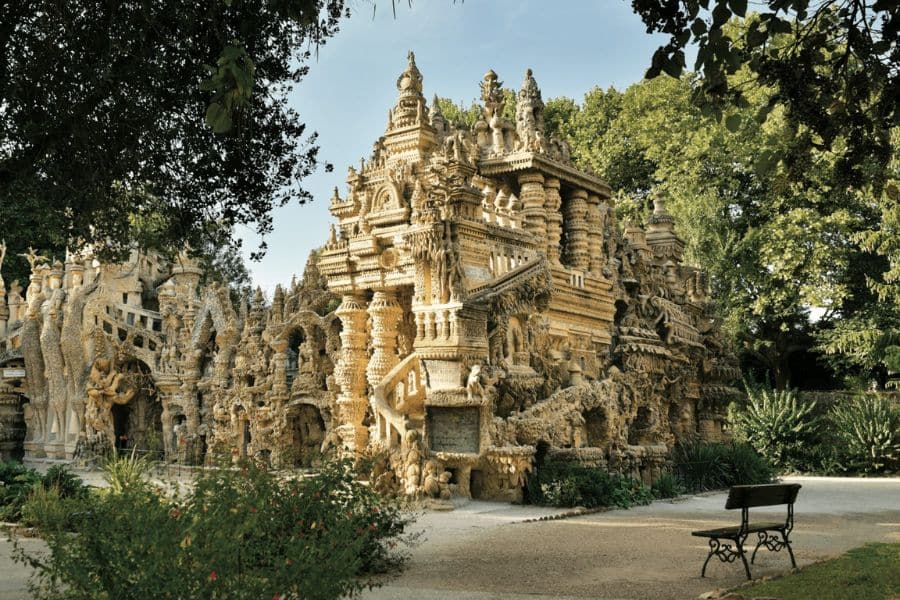
In the village of Hauterives in the Drôme, there is a palace unlike anything else you’ll have ever seen. Ferdinand Cheval was a rural postman who walked 30 kilometers a day on his rounds through the Drôme countryside. One April morning in 1879, he stumbled upon a stone of unusual shape and put it in his pocket.
He went back the next day and found more. That was the beginning. Over the next 33 years, working alone and carrying stones in a wheelbarrow, he built the Palais Idéal in his garden. The inscription on the north facade reads: “10,000 days, 93,000 hours, 33 years of effort.”
The building is covered in animals, caves, temples, grottos, and waterfalls, mixing styles from Hindu temples to medieval castles to a Swiss chalet. He taught himself as he went. André Breton visited and declared it a forerunner of surrealist architecture. Even Picasso came for a look.
André Malraux, as Minister of Culture, had it classified as a Historic Monument in 1969, specifically because it was the only example of naive architecture in the world. Cheval died in 1924 and is buried in a tomb he built himself in the village cemetery. The palace now draws around 150,000 visitors a year.
Explore Joan of Arc’s Prison in Rouen

The Tour Jeanne d’Arc is the only surviving tower of the medieval Château Bouvreuil in Rouen, built by King Philip II of France between 1204 and 1210. Joan of Arc arrived at the castle on December 23, 1430, after being sold by the Burgundians to the English for 10,000 livres.
She was imprisoned there and held for five months. The tower’s walls are four meters thick, and a steep spiral staircase leads to small exhibition rooms on each floor with manuscripts, paintings, and models of 15th-century life.
On May 9, 1431, Joan was brought to this very tower and shown the instruments of torture. She reportedly told her interrogators: if they pulled her limbs from her body, she would say nothing. She was tried on charges of heresy and burned at the stake on May 30, 1431, in the Place du Vieux Marché in Rouen.
During World War II, the Germans turned the tower into a bunker, and you can still see traces of the wartime camouflage paint on the exterior. It’s a 15-minute walk north from Rouen’s center, and admission is free.
Visit the Grave of Marc Chagall in Saint Paul de Vence

Saint Paul de Vence is a medieval walled village in the hills behind Nice, and it has been a magnet for artists since the 19th century. Marc Chagall moved there in 1966, at the age of 78, and stayed until his death on March 28, 1985. He was 97.
During his nearly 20 years in the village, he painted the landscapes, the light, and the hillsides, filling his canvases with the floating couples, goats, and roosters that became his signature. His home, La Colline on Chemin des Gardettes, remains private property.
He is buried in the village cemetery, which faces the Mediterranean. His grave is a simple white tomb covered in small stones placed there by visitors following Jewish tradition. Despite being Jewish, Chagall had specifically requested no religious service at his burial.
When you visit the cemetery, turn right at the entrance, then left, and you will find it. While you are in the village, the Fondation Maeght nearby holds one of the most important collections of his work in France.
Discover the Legend of d’Artagnan in the Gers

With all the excitement around d’Artagnan’s possible skeleton being found under the floor of a church in Maastricht, I couldn’t resist but include this. He was born Charles de Batz de Castelmore around 1611 in the village of Lupiac in the Gers, in Gascony.
He traveled to Paris in the 1630s using his mother’s surname, d’Artagnan, which opened more doors than his father’s name could. He rose to become captain-lieutenant of the Musketeers of the Guard, the most elite military unit in Louis XIV’s France.
His most famous assignment was the arrest of Nicolas Fouquet, Louis XIV’s finance minister, in 1661. He died at the Siege of Maastricht in 1673, and Louis XIV reportedly mourned the loss personally.
There is an equestrian statue of d’Artagnan in the town square of Lupiac, with both front hooves in the air, which, in equestrian statue tradition, means the rider died in battle. The Musée d’Artagnan is located in the Chapelle Saint Jacques, which was built by d’Artagnan’s own uncle. I visited last year, and it was fascinating to learn more about him.
Going back to the skeleton found for just a second, a French coin dated to around 1660 was found alongside it, and DNA testing is ongoing to determine if it really could be him.
Read About the Last Days of Eleanor of Aquitaine at Fontevraud Abbey

Fontevraud Abbey is in the Loire Valley, not far from Chinon, and it holds the tombs of some of the most consequential figures in medieval European history. Eleanor of Aquitaine retired here in 1200, at around 76.
She had quite a life, including serving as queen of both France and England, being imprisoned for 16 years by her husband, King Henry II, and outliving most of her 10 children. She died at the abbey on April 1, 1204, at around 82, an extraordinary lifespan for the era.
She is buried here alongside Henry II and their son Richard the Lionheart. Their painted stone effigies lie side by side in the abbey church, and Eleanor’s depicts her reading a book, which she specifically chose to reflect her lifelong passion for the arts.

The actual remains were likely destroyed during the French Revolution when the abbey was closed and later converted into one of France’s most severe prisons, which it remained until 1963. The effigies survived.
The abbey is a UNESCO World Heritage Site and remains one of the most significant Plantagenet sites in Europe. What you feel standing in that church with those four figures at your feet is not easily described, especially for a huge Alienor (the French spelling of her name) fan like me.
Wonder at the Harbor Monet Painted in Honfleur

Honfleur is a small port town on the Normandy coast where the Seine meets the English Channel, and it has been drawing artists for nearly 200 years. Claude Monet came here in May 1864 with his friend Frédéric Bazille and painted dozens of studies of the harbor, the jetty, and the surrounding countryside.
His painting Mouth of the Seine at Honfleur from 1865 was one of two works he exhibited at the Paris Salon that year and earned him his first significant critical praise. It now hangs in the Norton Simon Foundation in California.
The old harbor, the Vieux Bassin, is ringed by tall, narrow houses dating from the 17th century and a row of seafood restaurants. The boats that sit in it today look almost identical to the ones Monet painted.
Eugène Boudin, who was born in Honfleur and became Monet’s mentor, painted here throughout his career. The town has its own dedicated museum, the Musée Eugène Boudin, which holds works by both him and Monet alongside other artists who painted in the area.
Come in the late afternoon when the light on the water turns, and the harbor looks exactly the way it did in those paintings.
Relive History at the Arles Roman Amphitheater

The amphitheater in Arles was built in 90 AD and could hold more than 20,000 spectators. It is 136 meters long, 109 meters wide, and has 120 arches across two levels. It was modeled on the Colosseum in Rome, which was completed a decade earlier.
For centuries, it hosted gladiatorial fights, animal hunts, and chariot races. When the Roman Empire collapsed in the fifth century, the amphitheater was turned into a fortress, then into a self-contained town with more than 200 houses, two chapels, and a public square built inside the arena itself. People lived in it for over a thousand years.
In the early 19th century, the houses were cleared out, and the arena was restored. The first event held there in 1830 was a bull race celebrating France’s capture of Algiers. Bullfighting has been part of the calendar ever since, and today the arena hosts the Feria d’Arles twice a year, in April and September.
In 1888, Vincent van Gogh painted a bullfight taking place inside it, a canvas called Les Arènes. The amphitheater is a UNESCO World Heritage Site. You can walk the same corridors Roman spectators used, climb to the upper tiers for views across Arles, and watch gladiatorial reenactments in the summer.
Arles is second only to Rome in the concentration of Roman monuments it holds within its city limits.
TRAVELLING TO FRANCE?
Here are my favourite resources I use each time I travel!
🧳 I always protected my trips with this travel insurance company when I lived in the US AND this one now I live in Europe
🚘 I found a car rental for $500 less than traditional sites with this car rental agency
🚌 🍷 My favourite platform to find Day Trips and Wine Tours in France at the best price and with great reviews
🚂 The cheapest train tickets are always on this App
🏨 I got a 20% discount on a chateau hotel with this hotel booking tool
I personally use these sites myself and if you use them, they will earn me a small commission at no extra cost to you. This helps reduce the ever-increasing cost of maintaining my blog and writing about France. Thank you!